
Abubakar Nataala A. DAÏO: a high-specificity real-time vision-based fall detection system using advanced kinematic tracking and computer vision. Series Clin Biomed Res. 2026;3(1):1-12.
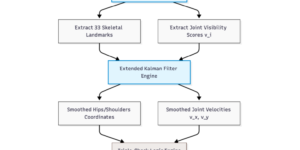
Rapid and highly specific fall detection is critical to preserving the health and autonomy of vulnerable elderly populations. While existing vision-based fall detection architectures promise non-intrusive monitoring, they suffer from high false positive rates (FPRs) triggered by ordinary activities of daily living (ADLs) and severe performance degradation under joint occlusions. This paper presents DAÏO (intelligent vision-based fall detection system), a novel, edge-capable, high-specificity computer vision framework designed to address these limitations. DAÏO operates on a hybrid architecture combining a lightweight human pose estimator, an extended Kalman filter (EKF) with adaptive measurement noise, and a stateful Triple-Check Logic Engine. By tracking joint dynamics and mapping them through an adaptive mathematical state-space model, the system adjusts to occlusion events dynamically using visibility confidence scores. Falling actions are validated across spatial, rotational, and kinematic dimensions in parallel, filtering out high-velocity non-fall events (such as prostrations, deep squats, and rapid sitting) via a velocity latching mechanism.
Evaluated against a composite dataset comprising 340 video sequences (~153,000 frames) from the UR Fall Dataset, the Multiple Cameras Fall Dataset (MCFD), and customized stress-test scenarios, the system achieved an overall accuracy of 95.3%, a sensitivity of 93.3%, and a specificity of 96.4%. Crucially, the velocity latch cut false positive alarms by 79.7% compared to baseline posture-only models, demonstrating 100% specificity during active, repetitive religious prostrations. Running locally at 35.7 FPS on consumer workstations and 12.3% on a Raspberry Pi 4, the proposed system demonstrates high specificity, operational reliability, and privacy preservation at the network edge.