Commentary
Full TextPDF
Review Article
Abstract
Full TextPDF Chronic diseases, such as childhood diabetes mellitus (DM), are a challenge for sick children and their families. Paediatric DM is characterized by a complex therapeutic management treatment, which has a physical and psychological effect on the whole family and entails multiple losses for the parents. Investigators point out that parents of children with DS react to the diagnosis with anger, denial, frustration, and depression and that mothers differ in their reactions from fathers. The teenager goes through a very intense period of his life, full of emotional tensions and outbursts, anger, sorrow, fear, and shame for his desires, thoughts, and himself. Thus, a disease in the period of adolescence is very likely to harm the adolescent's self-image and negatively affect body image and perception of strength and ability. For this reason, the investigations carried out in the context of this field are necessary to focus not only on the needs of the children but also on those of their parents, as this is how it can be achieved better control. Despite all the difficulties in the management of the chronic disease of their child, it seems that the families of diabetic children adequately respond to the demands of intensive care and probably manage satisfactorily the psychological, social, and physical levels of their child's chronic illness.
Research Article
Abstract
Full TextPDF Background: Over the last few years, the use of potassium bromate in bread has been the subject of many scientific arguments in Libya. The Food and Drug Control Center in Libya banned the use of potassium bromate in bread on account of its deleterious effect and carcinogenicity in humans. However, the current research presents conflicting results on its use in bread.
Aim: This study aimed to examine the knowledge and increase awareness among the population about the use of this substance in bread. In addition, it looked at some aspects of bread making in bakeries.
Methods: A cross-sectional study was conducted on the general population during the period from Feb 2021 to May 2021. An electronic questionnaire was designed using Google Forms and distributed through social media.
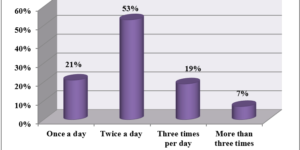
Results: A total of 500 participants responded to the electronic survey and were included in this study. 79% females and 21% males with an age range from 20–30 years. The majority of participants were from Benghazi (92%) and Libyan nationality (97%). 76% did not have any health problems, whereas 24% had some diseases. 50% of them consumed bread twice a day. Only 12% of participants had awareness about the Libyan standard for bread making, while half of them (51%) did have any knowledge, and about 38% of them did not know any information about these standards. Most of the participants (71%) did have any information about potassium bromate as a food additive. Only 31% of participants reported that potassium bromate is a banned substance, whereas around half of them (52%) did not know that. Most of the participants (65%) did not know the effects of potassium bromate on their health. The majority of them suggested that the health inspection office, municipal guard, and the Ministry of Economy have the responsibility of monitoring the use of food additives in the bakery.
Conclusion: This study highlights the low level of knowledge of respondents regarding food additives, especially potassium bromate. Education programs to increase awareness among people are highly recommended. Further scientific investigations are needed.
Research Article
Abstract
Full TextPDF Recently, there is a huge interest in the use of the Self-Efficacy for Appropriate Medication Use Scale (SEAMS) to evaluate perceived medication adherence across cultures. The aim of the present study was the translation as well as the cultural adaptation of the Greek version of the SEAMS. In this study, 10 patients diagnosed with end-stage kidney disease (ESKD) undergoing hemodialysis participated. The whole process included the steps of translation - back translation and semantic evaluation. The scale indicated very satisfactory acceptance of the translated version of the instrument, which participants considered easy to understand. After completing the process of the translation as well as the cultural adaptation in Greece, the SEAMS will be available to Greek researchers in order to measure self-efficacy for appropriate medication use as well as to compare results from Greece to those coming from other cultures, where the tool has already been validated.
Case Report
Full TextPDF
Short Communication
Abstract
Full TextPDF Point-of-care ultrasound (POCUS) is an essential tool for medical assistance in all scenarios and specialties. In this paper, the main uses of POCUS in otolaryngology and head and neck surgery are described.
Case Report
Abstract
Full TextPDF Heart failure is a clinical syndrome that is easily treated with medications and lifestyle interventions, however, failure to comply with treatment leads to poor clinical outcomes, repeated hospitalizations, complications, worsening of the disease, an increase in health care costs even death. Adherence of patients with heart failure to treatment is one of the main goals of daily clinical practice. This paper presents a case of a male patient suffering from heart failure indicating a low level of adherence to medical instructions, particularly to the attendance of a rehabilitation program.
Research Article
Abstract
Full TextPDF Background: The purpose of this research is to study the effect of occupational therapy on the quality of life and pain self-efficacy among chronic disease patients. In this context, differences in quality of life and pain self-efficacy were investigated between patients who have followed occupational therapy and patients who have not followed the program of occupational therapy. Methods: The sample consists of 63 people, all chronic disease patients. Of the above patients, according to the research design, half received occupational therapy services at a rate of 50.8% (32 patients), while the remaining 49.2% (31 patients) did not receive them. For the data collection MVQOLI-15 and PSEQ were used. Results: We found that those receiving occupational therapy services, on average, seem to have comparatively better pain self-efficacy and overall quality of life compared to those not receiving them, while this difference is statistically significant, with the level of statistical significance amounting to α = 5%. Conclusion: The effect of occupational therapy on quality of life and pain self-efficacy in chronic disease patients is crucial.
Review Article
Abstract
Full TextPDF Objective: Obesity is a very common health problem and is considered a global non-communicable disease by the World Health Organization (WHO). Modern-day obesity is mainly due to physical inactivity, a high-calorie diet, and a sedentary lifestyle. It is associated with a multitude of commodities, such as diabetes type II, cardiovascular disease, hypertension, and even cancer. Due to this, obese patients are more likely to present for health assessment and are more likely to require imaging. The size of these patients brings diagnostic challenges involving gantry size, image quality, and radiation exposure. This review article compiles all the challenges and new techniques to overcome them during the imaging of the obese.
Key findings: There are many challenges to imaging the obese, as mentioned. Each modality also has its own specific set of challenges. There have been efforts to overcome these shortcomings, and many manufacturers now produce machines with higher weight load capacity and many other features to improve imaging of the obese, as mentioned in this article.
Conclusion: Obese patients face unique challenges in medical imaging and intervention. Over the last few years, medical manufacturers, radiographers, and radiologists have recognized these issues and come up with innovative techniques to overcome these challenges.
Implications for practice: Technical challenges of imaging obese patients need to be known and addressed, as mentioned in this paper.
Review Article
Abstract
Full TextPDF Severe acute respiratory syndrome coronavirus 2 (SARS-CoV-2) is defined as the virus causing the present coronavirus disease outbreak (COVID-19) that has been initially discovered in Wuhan, China after complaints of severe pneumonia. The impact of vitamin D on complications and treatment of COVID-19, as well as its potential role in lowering the incidence of COVID-19, has been the subject of much investigation. The correlation between COVID-19 infections and vitamin D will be demonstrated in the presented work.






![Figure 1: Schematic representation of vitamin D and its metabolites and action of 1,25-dihydroxyvitamin D on the innate and adaptive immune system [12].](https://seriesscience.com/wp-content/uploads/2022/12/Figure-1-1-300x150.jpg)